
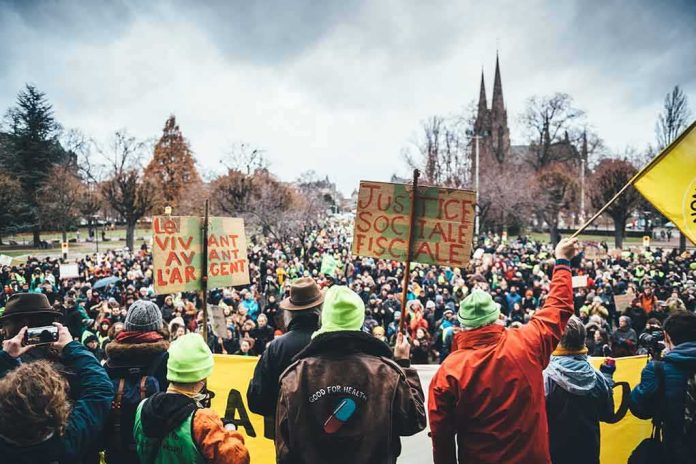
When a country argues about what to call its unrest, it is really arguing about what to do next; in France’s recent turmoil, the strongest evidence shows a student-led mobilization over schooling that drew in wider currents—and, on the margins, turned violent.
The Short Version
- The mobilization began in high schools around concrete education failures—missing teachers, overcrowded classes, and dilapidated facilities—before expanding.
- Authorities counted roughly a quarter-million demonstrators nationwide on the peak day; organizers cited a larger figure, a familiar French gap in crowd estimates.
- Most marches were peaceful; violence occurred at the fringes, with clashes, fires, and property damage documented across several cities.
- Competing narratives—especially identity-based frames—lack systematic evidence that religion was the movement’s driver; the backbone is education-sector grievances.
What the movement was actually about: concrete failures in schooling
The clearest through-line is pedagogical, not theological. Student unions and education-sector groups called blockades and marches to protest a set of measurable deficits: teacher vacancies that left timetables in tatters; overcrowded classrooms degrading instruction; crumbling buildings; and chronic resource shortages. The Union Syndicale Lycéenne, France’s national high school student union, explicitly organized around these themes, urging nationwide action after weeks of local blockades. Reporting from multiple outlets consistently described picketed lycées, improvised barricades at school entrances, and lists of demands that stayed squarely on education—staffing, funding, safety, facilities—rather than religious identity or foreign policy.
This origin matters because it anchors the taxonomy. Movements evolve: teachers, parents, university students, and allied unions joined in subsequent days, and some protesters voiced broader grievances about austerity, policing, or the far right. That does not erase how the thing started or what sustained the core messaging. In France’s long history of social protest, knowing the initiating fault line helps separate structural diagnosis from the opportunistic overlays that inevitably accrue once a crowd is in the streets.
Scale and spread: how the protests became national
On the largest day of mobilization, the Interior Ministry counted roughly 256,000 to 266,000 participants across more than 40 cities, with visible surges in Paris, Marseille, Lyon, Lille, Toulouse, and Caen. Organizers argued the true number neared 450,000—hardly unusual in France, where official and organizer counts routinely diverge by large margins, reflecting different methods and incentives. The gap is real, but it does not obscure the essential point: this was not a cluster of isolated schoolyard scuffles; it was a geographically broad movement with tens of thousands in the streets in dozens of jurisdictions.
French protest numeracy is its own minor science, and the familiar discrepancy should be read as a politics-of-counting story, not a referendum on whether a mobilization happened. Analysts who study French contention note the persistence of such gaps across movements, from pension reforms to student uprisings—partly because unions and ministries optimize for different risks and optics.
Peaceful marches with violent fringes: a mixed protest-and-riot profile
Most marches were reported as peaceful; still, parts of the country saw violence. There were localized clashes with police, fires and arsons near or in schools, damage to facilities, and injuries among students, staff, and law enforcement. Interior officials said hundreds of police and gendarmes were injured over the course of the mobilization, and arrests mounted across several cities. Journalists on the ground repeatedly distinguished between the large peaceful blocs and the smaller groups at the periphery where escalation occurred, a pattern long familiar to crowd-control professionals: the modal participant demonstrates, while a thinner fringe tests the line.
This duality complicates simplistic narratives. It is both true that many students and educators marched to demand smaller classes and working heat, and also true that some schools were burned and some officers hurt. Conflating the two—either to sanitize all unrest as civic-minded or to condemn the whole as nihilistic violence—misreads the operational reality that police, administrators, and mayors faced in mixed-motive, multi-city events.
Competing frames: why identity narratives outpaced their evidence
Some commentators and political figures recast the unrest as a Muslim or migration-driven uprising. Those claims rest on assertion, selective incidents, and political inference rather than a systematic demographic or motivational profile of participants. The underlying reporting that documents the movement’s genesis—school blockades, union calls, and student demands—does not establish a religious driver; it identifies organizers by role (students, teachers, unions), not creed. Without arrest-level data, participant surveys, or verified demographic breakdowns, identity-based attributions remain conjectural overlays on a movement whose articulated grievances were scholastic.
France has been here before. Scholarship on the 2005 riots showed how actors “diagnosed” the same unrest through clashing frames—criminality, policing, social exclusion, ethnic conflict—each implying different remedies. The caution those studies counsel is simple: avoid category substitution, where a movement rooted in one domain is re-labeled into another to win a political fight. In the student mobilization, the burden of proof for an identity thesis would be arrest and case data linking perpetrators and organizers to a coherent religious project; that evidence has not been produced in public.
Mechanics of escalation: policing, crowd composition, and information flows
Escalation dynamics in France’s street politics are well studied. Heterogeneous crowds—students, educators, union contingents, unaffiliated youths—interact with layered policing (prefect-led deployments, CRS riot units, gendarmerie). Tactical decisions at choke points around schools or squares can turn a tense standoff into a rout; tear gas and water cannons disperse but also scatter and radicalize. Meanwhile, smartphone video collapses time and space, amplifying the most dramatic fifteen seconds—an arson plume, a baton charge—until those images become the movement’s public face. That feedback loop was on full display here, where “mostly peaceful” and “shocking violence” coexisted, with the lens drawn reliably to the latter.
None of this excuses criminal conduct or negates legitimate grievances. It does explain how a protest over missing math teachers can end the day with burned doors and broken teeth, and why policymakers misread the field if they address only the spectacle without tending to the substrate that put thousands at the gates of their schools in the first place.
What would settle the disputed questions
Three datasets would convert inference into knowledge. First, incident-level logs from the Interior Ministry separating peaceful marches, school blockades, arrests, injuries, arsons, and assaults by time and location. Second, anonymized arrest and prosecution records indicating age, student enrollment status, alleged offenses, and case outcomes—evidence to validate or refute claims about who committed violence. Third, audited damage assessments from education authorities, municipalities, and insurers to substantiate aggregate loss figures that have circulated without sourcing. These are routine administrative records in French governance; releasing them—appropriately anonymized—would upgrade debate quality and policy design.
What it means for policy: fix the schools, police the fringes, resist false binaries
France can hold two ideas at once. The students’ core claims about the condition of schooling—with teacher shortages, overcrowding, and facility decay—are legitimate and documented; addressing them is a matter of public investment, workforce planning, and building safety. Simultaneously, the state must deter and prosecute arson and assaults that piggyback on mass mobilizations. The strategic mistake is to collapse the first into the second or to let an identity frame—unsupported by comprehensive evidence—crowd out the practical work of hiring teachers, reducing class sizes, repairing buildings, and modernizing crowd-management doctrine. That is how you lower the temperature next time: tend the root, constrain the fringe, and name the thing for what the record shows it is—a student-led movement that at times was exploited at its edges.
Sources:
thegatewaypundit.com, npr.org, lemonde.fr, afp.com, nytimes.com, time.com, rte.ie, x.com, france24.com