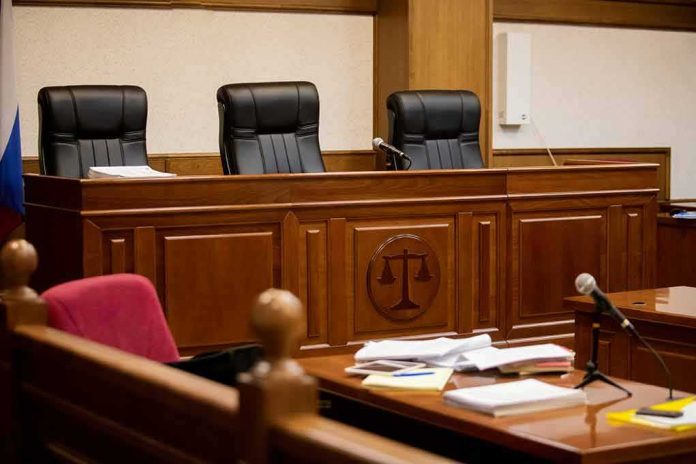
When a constitutional court becomes the battlefield, the rule of law is no longer an abstraction; it is the prize. Poland’s latest confrontation over its Constitutional Tribunal is not a one-off drama but the predictable culmination of a decade of institutional hardball in which each side claims legality, and both sides deepen the court’s political entanglement.
At a Glance
- The government framed the suspension of the Tribunal’s president as lawful, citing a statutory mechanism and alleged obstruction of judges elected by the current parliamentary majority.
- The counter-case is specific and direct: the Tribunal’s official channel called it a coup and denied the suspending judge’s legal status; prominent constitutional lawyers questioned the legal basis.
- Police securing the court turned a legal dispute into a spectacle of force, reinforcing claims of capture on one side and restoration on the other.
- The decisive question is authority: who counts as a lawful judge, and which statute governs discipline at a constitutional tribunal—issues that remain contested in real time.
What the government says it did—and why it says it could
Ministers tied the one-month suspension of Bogdan Święczkowski and his deputy to a concrete allegation: that they obstructed judges elected by the current parliamentary majority from taking up adjudicatory duties and manipulated case assignment. The justice minister and prosecutor general sought to lift their immunities to allow potential criminal charges; contemporaneous reporting attributed months of obstruction to Święczkowski’s leadership. Procedurally, the move was presented as a judicial measure rather than a political purge: the Tribunal’s notice—posted before the website went offline—cited Article 130 of the law on common courts, which allows an immediate interruption of a judge’s duties when allegedly caught committing an offence, with referral to a disciplinary court to review or revoke the suspension after a month. Prime Minister Donald Tusk situated the action inside a declared rule-of-law restoration program that targets what the government describes as institutional degradation under prior administrations.
Those pillars—specified misconduct, a statutory hook, and an avenue for review—give the government’s narrative legal texture. But they do not resolve the two questions that matter most to constitutional lawyers: whether Article 130 applies to the Constitutional Tribunal at all and whether the official who invoked it had the authority to do so. On both, the record is incomplete in the public domain.
The counter-case: disputed authority, disputed law
The Tribunal’s official communication channels rejected the entire move as ultra vires: Święczkowski and his deputy, it said, remained the lawful senior judges; participants in the suspension were committing a coup d’état. The same account insisted that Anna Korwin-Piotrowska—the judge who announced the suspensions—was not a Tribunal judge and therefore could not act as its presiding authority. That is not ambient skepticism; it is a direct, named, institutional contradiction of the core predicate to the government’s action.
Independent constitutional-law criticism sharpened the point. Marcin Matczak, an academic who has criticized the Tribunal’s prior leadership, argued that the legal basis for suspending Święczkowski was nonexistent and that the justice minister’s supervisory remit over common courts does not extend to the Constitutional Tribunal. The skepticism overlaps with a well-known doctrinal line: constitutional tribunals often sit outside ordinary judicial hierarchies, which makes borrowing disciplinary tools from the ordinary courts contestable without an explicit constitutional or statutory bridge.
What is known, what remains unclear
Several facts are uncontested. Police secured the Tribunal’s premises as protesters gathered; some were detained after breaching fencing and throwing objects. Political actors treated the event as existential: opposition figures called for resistance; the president cut short travel and engaged with judicial leaders. The government’s public rationale centered on blocked assemblies, irregular case assignments, and exclusion of newly elected judges; yet the underlying documents—assignment logs, formal orders, or sworn accounts by named judges—were not circulating alongside the claims at the time. The Tribunal posted a short suspension notice that soon vanished with the site’s outage, obscuring access to the full legal rationale.
For readers who prize institutional proof, these gaps matter. The availability of a disciplinary review after one month is a safeguard only if the initiating authority and the governing statute are sound. Conversely, if the initiating act is jurisdictionally void, no subsequent review cures it. The case therefore rests on two traceable dossiers: the legal status of Korwin-Piotrowska (parliamentary election, presidential oath, and any prior rulings bearing on her status), and the applicability of Article 130 or any cognate provision to Tribunal judges as opposed to judges of the common courts.
How we got here: a decade of constitutional hardball
Poland’s Tribunal has been a focal point of politicization claims since 2015: appointments under the previous governing majority drew sustained domestic and European scrutiny, including a 2021 European Court of Human Rights judgment holding that participation by an unlawfully elected person violated the right to a tribunal established by law. Comparative work on constitutional courts explains why crises like this recur. Courts that arbitrate constitutional meaning are appointed by elected actors; when the appointment pipeline tilts decisively, incentives arise to entrench allies, label successors illegitimate, and treat “restoration” as a mirror image of prior “capture.” Scholars have described the European mixed-appointment model as structurally vulnerable to these cycles.
In this lens, Poland is traveling a well-mapped road: one majority engineers change; opponents question the court’s composition; a successor government declares the institution captured and attempts to reset it; both sides cite legality as each escalates. Once police are on the court’s lawn, the optics compress the legal nuances into a single image—power policing the constitution—no matter which side ordered the cordon.
Where the real legal disagreement lies
Strip away the slogans and the live disputes reduce to four justiciable questions.
First, status: was Korwin-Piotrowska lawfully elected and sworn as a Tribunal judge? That turns on parliamentary resolutions, presidential oath records, and any Tribunal or high-court judgments on point. The government’s position presupposes an affirmative answer; the Tribunal’s channel says otherwise.
Second, competence: does Article 130 of the law on common courts, or any other statute, authorize an “immediate break in duties” for Constitutional Tribunal judges? The government’s reference to Article 130 supplies a textual anchor; critics argue the Tribunal sits outside the common-court framework, and no explicit disciplinary cross-reference has been publicly demonstrated.
Third, fact pattern: did Święczkowski obstruct the seating or work of judges elected by the current majority and engage in unlawful case assignment? The allegation is specific—blocked assemblies, budget plan delays, and exclusion from panels—yet the supporting administrative record has not been publicly produced in full.
Fourth, policing authority: who requested the police presence, under which legal instrument, and to what end—public order, execution of a lawful internal measure, or both? The reporting records the deployment and arrests but not the precise legal order; this matters for proportionality and for claims of coercive capture.
Political crisis erupts in Poland: Police deployed at Constitutional Tribunal amid ‘coup’ allegations, President Nawrocki turns plane around – ProtoThema English https://t.co/24IZvE4bDU
— Mirosław Szulczyński (@izka1702) October 31, 2026
What it means going forward
In constitutional crises, process is the remedy and the test. If the suspension stands or is regularized through a body with uncontested jurisdiction, it will set a precedent for treating the Tribunal’s leadership as disciplinable through ordinary-judiciary tools—reshaping Poland’s separation of powers. If it fails on status or competence, it will reinforce a different precedent: that even in the name of restoring the rule of law, executive-aligned actors cannot reach into the Tribunal with instruments designed for other courts. Either outcome raises the same strategic lesson seen across Europe’s mixed-appointment systems: unless appointments and discipline are insulated by design, each transfer of political power will reopen the court’s composition as a live political contest, and public trust will erode accordingly.
The fastest path to clarity is documentary, not rhetorical. A complete suspension order with legal reasoning; the prosecutor general’s immunity-lifting application; logs of panel assignments and assembly convenings; and authoritative records on Korwin-Piotrowska’s status would let the law do its work. Until then, the opposing banners—coup versus restoration—are less analysis than marketing. The stakes, however, are real: the capacity of a constitutional tribunal to decide constitutional questions that bind political winners and losers alike.
Sources:
youtube.com, theweek.in, en.wikipedia.org, aljazeera.com, notesfrompoland.com, meduza.io, bloomberg.com, winnipegfreepress.com, yahoo.com