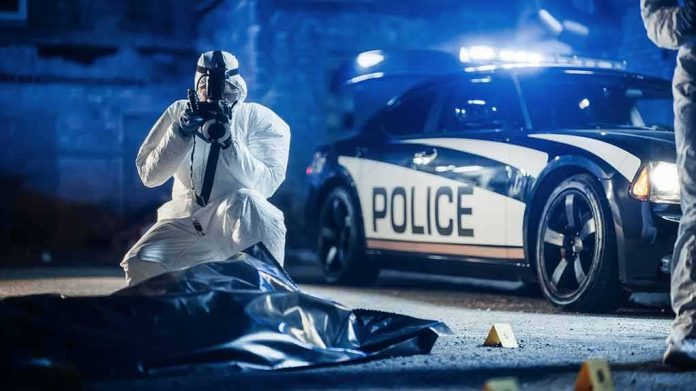
In the Houston ICE shooting case, the dispute over whether a “white crystal-like” substance in the van was methamphetamine or simply crystallized salt exposes a familiar pattern: untested drug allegations deployed to frame a deadly use of force, set against local officials and families who question both the evidence and the narrative built around it.
Key Points
- The FBI affidavit relies on visual observation and packaging to suggest the substance in Lorenzo Salgado Araujo’s van was consistent with methamphetamine, but no lab confirmation exists.
- Araujo’s family and their attorney say the bags held a homemade electrolyte mix—granulated salt used by outdoor workers in Texas heat—directly contradicting the FBI’s drug implication.
- Harris County DA Sean Teare publicly doubts the substance is drugs and stresses that, even if it were, it has no bearing on whether the shooting was justified.
- The Harris County Medical Examiner has ruled Araujo’s death a homicide, intensifying scrutiny of ICE’s self-defense claim and the role the drug narrative may play in shaping public perception.
- This clash sits inside a broader pattern of ICE shootings where federal immunity, opaque investigations, and post-hoc allegations about victims frequently complicate accountability.
How the “Crystal-Like Substance” Entered the Story
The substance at the center of this controversy entered the public record not at the moment of the shooting, but a week later, when the FBI applied for a federal search warrant on Araujo’s van. Special Agent David McNeilly (also reported as McNielly or McNeely in coverage) stated that, upon arriving at the scene after the fatal encounter, he observed “several plastic bags with what appeared to be a white crystal-like substance” on the dashboard and floorboard of the van. Based on his training and experience, he wrote that the appearance and packaging were “consistent with methamphetamine” and with how controlled substances are commonly packaged for distribution or possession.
That observation was then used to establish probable cause for a warrant targeting possible drug offenses—possession with intent to distribute and simple possession—and to justify a more thorough search of the vehicle. The affidavit notes that agents believed they already had authority under the automobile exception but sought a warrant “out of an abundance of caution,” underscoring that the drug claim was structurally important to the investigative posture, even though it arrived after the shooting itself.
What the Evidence Does—and Does Not—Say About Drugs
Crucially, the FBI document stops short of claiming that the substance was definitively methamphetamine. It acknowledges that laboratory testing had not yet confirmed the substance’s identity and that the search warrant “does not determine whether a crime occurred.” In other words, the drug allegation rests entirely on visual assessment of crystals in plastic bags and an inference from packaging, not on chemical analysis.
Visual and packaging-based identification is, at best, a preliminary tool. Forensic literature has repeatedly documented that various inorganic salts and legal substances can form crystal structures that resemble illicit drugs. Without confirmatory techniques—gas chromatography/mass spectrometry (GC-MS), infrared spectroscopy, or similar methods—crystal appearance alone is a notoriously unreliable indicator. Experienced narcotics investigators use appearance and packaging to justify further testing, not to make definitive claims about guilt.
This distinction matters because the warrant language has already been used in media and political discourse to suggest that Araujo was driving a drug-laden van, implicitly aligning him with criminality and potentially shaping public attitudes toward the shooting. Yet, on the record, the evidence remains tentative.
The Salt and Electrolyte Mix Counter-Narrative
Against the FBI’s implication stands a detailed, alternative explanation from the family and their attorney. Ruby Powers, representing Araujo’s brother Victor, has stated publicly that, after consulting with the family, her understanding is that the substance was “granulated salt,” part of a homemade electrolyte mix combined with lemon and water. The family describes this as a routine preparation used by outdoor workers to stay hydrated in extreme Texas heat—a context that will be immediately legible to anyone who has worked construction or landscaping in Gulf Coast summers.
Local coverage reinforces this account. Houston outlets report that the family views the bags as containing a drink mix, not narcotics, and that Powers’ statement is grounded in conversations with multiple relatives, not a speculative theory. In televised interviews, she has gone further, characterizing the drug claim as part of a “smear campaign” against a man who cannot speak for himself and whose surviving relatives now face both detention and a rapidly hardening public narrative.
This is not merely a vague denial; it is a specific alternative consistent with both the setting and known forensic pitfalls. Salts and household mixtures can crystallize in ways that mimic controlled substances visually; field officers are trained to treat such observations as suspicion, not as proof. When a family offers a plausible benign explanation, and when no lab report contradicts it, the responsible stance is to treat the substance’s identity as unresolved.
The Harris County DA’s Skepticism and Its Significance
Harris County District Attorney Sean Teare has added an institutional voice to the family’s challenge. In interviews and social media posts, Teare has said that, “just eyeballing the evidence,” his office does not believe the substances collected from the van are drugs. He has emphasized that the material is still undergoing testing, but based on what investigators learned about the passengers, it is “inconsistent that drugs were in the van.”
Teare’s skepticism matters for two reasons. First, it signals that local prosecutors, who routinely evaluate narcotics cases, see no obvious basis to treat the substance as contraband. Second, Teare has argued that even if the bags did contain drugs, that fact would have “no bearing whatsoever” on why Araujo and the three others were targeted, or on whether the use of deadly force was justified. From the perspective of a death investigation, the drug allegation is a narrative add-on, not a core evidentiary pillar.
That distinction cuts against a familiar rhetorical pattern: after controversial police shootings, post hoc revelations of alleged drugs or other misconduct are often used to implicitly rationalize the killing, even when legally irrelevant. Teare is explicit that the shooting’s legality turns on the events at the moment force was used—positioning of vehicles, threat assessments, officer conduct—not on what might have been in a plastic bag on the dashboard.
Homicide Ruling and the Self-Defense Claim
While the substance’s identity is contested, one point is clear: the Harris County Medical Examiner has ruled Araujo’s death a homicide. In forensic terms, “homicide” simply means death at the hands of another, not necessarily murder. But in this context it underscores that the killing was not classified as accident or suicide; someone’s intentional act caused Araujo’s death.
ICE and the Department of Homeland Security contend that the agent acted in self-defense, claiming Araujo “weaponized” his work van by ramming an ICE vehicle and attempting to run over an officer. The family, their attorneys, and detained witnesses vehemently dispute this, reporting that ICE vehicles struck Araujo’s van and that agents were never positioned in front of it. Bystander photos circulated by civil rights groups reportedly show little or no visible damage to the van, raising further doubts about the alleged ramming.
The clash over physical positioning and vehicle damage is independent of the drug question—but the two narratives have begun to intertwine. An implication that drugs were present can subtly shift public perception, nudging observers to accept a more aggressive enforcement posture as reasonable. The homicide ruling and the absence of body or dash camera footage, however, keep the underlying self-defense claim on uncertain ground.
Why “Crystalized Salt vs. Meth” Matters Beyond One Case
To understand why this dispute has resonated beyond Houston, you have to place it in ICE’s broader history of deadly force and accountability. Investigative reporting has identified at least 59 ICE shootings between 2015 and 2021, resulting in 23 deaths across 26 states and two U.S. territories. More recent compilations show an uptick in fatal encounters involving ICE and CBP agents since the start of Donald Trump’s second term, with multiple deaths tied to traffic stops and vehicle interactions.
In case after case, federal officials frame shootings as self-defense, often citing vehicular threats or alleged criminal conduct by the deceased. But because ICE agents operate under federal authority, they enjoy layers of protection that local officers do not. Legal analysts have described “absolute immunity” doctrines that shield federal agents from state prosecution, effectively shifting investigations into federal hands and sidelining local jurisdictions.
Within that structure, allegations of drugs or other criminal activity can function as narrative force multipliers. They do not necessarily change the legal analysis of a shooting—particularly when they arise after the fact—but they do shape media coverage, public empathy, and political appetite for reform. When those allegations rest on untested visual impressions of crystals in plastic bags, the risk that they are being used more for spin than for truth is substantial.
The Forensic Path Forward: What Would Actually Resolve the Dispute
From a forensic standpoint, resolving the “crystalized salt vs. meth” question is straightforward in principle, even if institutional delays complicate practice. The seized substance should be subjected to standardized chemical analysis: GC-MS to identify organic compounds, infrared spectroscopy to confirm molecular structure, and, where appropriate, ion chromatography for inorganic salts. A transparent report from an independent laboratory—summarizing methodology, results, and margins of error—would provide far more clarity than any affidavit or press release.
Equally important is separating the substance’s identity from the lethal-force investigation. As DA Teare has argued, whether the bags held salt or meth does not answer why an ICE agent fired into a van during a traffic stop, nor why Araujo, who was not the original target of the operation, is dead. That inquiry depends on physical evidence (ballistics, vehicle damage, trajectory analysis), witness testimony from the three detained men, and any available surveillance video from nearby businesses.
Until those elements are brought forward with appropriate rigor, the temptation to seize on a contested drug allegation as a proxy for truth should be resisted. For readers and citizens trying to make sense of the case, the most defensible position is to treat the substance’s identity as unresolved, to recognize the plausibility of both the FBI’s suspicion and the family’s electrolyte mix explanation, and to insist that the ultimate judgment about the shooting rest on the facts of the encounter itself.
Attorney for Witness to ICE Fatal Shooting Tells CNN Alleged Drugs in Vehicle Just ‘Crystalized Salt’ (by Stephanie Kaloi)
An unsealed search warrant revealed the FBI accused Lorenzo Salgado Araujo, the father of three shot to death by an ICE agent in Texas last week, of having…
— Tina M Long (@TinaMGLong) July 18, 2026
How to Read Official Claims in Cases Like This
For an informed observer, the Houston case offers a template for critical reading. When you encounter an affidavit or official statement invoking “white crystal-like substances” and “packaging consistent with methamphetamine,” treat it as what it is: a claim of probable cause to search, not a conviction or a fully tested chemical conclusion. Look for the follow-up: Is there mention of lab results, dates of analysis, specific tests used? If not, the assertion belongs in the category of investigatory suspicion.
At the same time, take seriously specific, alternative explanations from affected families, especially when they align with known forensic pitfalls and everyday practices—like workers preparing salt-based drink mixes to withstand 100-degree heat. A credible DA’s skepticism amplifies that signal: when prosecutors who routinely handle drug cases say they doubt an item is contraband, you are no longer in the realm of “activist disagreement”; you are in the realm of professional dispute.
Finally, remember the structural incentives at work. Federal agencies defending their officers after a controversial shooting have every reason to emphasize facts that cast the deceased in a criminal light, and comparatively less incentive to highlight ambiguity or exculpatory possibilities. Recognizing those incentives does not mean assuming bad faith in every case; it means insisting that consequential claims—especially those that shape our view of a killing—be grounded in more than the glance of an agent at a handful of crystals on a dashboard.
Sources:
mediaite.com, click2houston.com, springnews.org, facebook.com, cnn.com, instagram.com, youtube.com, dea.gov, chemistry.mdma.ch, ojp.gov, reddit.com, factually.co, houstonchronicle.com, americanimmigrationcouncil.org, nytimes.com