A dangling truck cab, a driver kicking through his own windshield, and a knot of strangers holding a blanket taut beneath him — that single sequence explains more about how modern crash coverage works than any statistic on highway fatalities could, because the image of rescue will always travel farther and faster than the paperwork of cause.
Key Points
- A crash on northbound I-5 near Washington Street in San Diego’s Mission Hills area, around 9:45 a.m. on October 20, 2026, left a truck cab hanging over the center divider.
- Video shows the truck driver escaping through the windshield and dropping into a blanket held by bystanders below; a second truck occupant was helped out through a window.
- Both truck occupants refused medical treatment at the scene; reporting differs on whether three or four people from the sedan were hospitalized.
- The collision sparked a fire and fuel leak, closing I-5 in both directions for hours during a Tuesday morning commute.
- The crash’s precise cause and fault remain under investigation; no collision report or reconstruction has been made public.
What Happened on I-5 That Morning
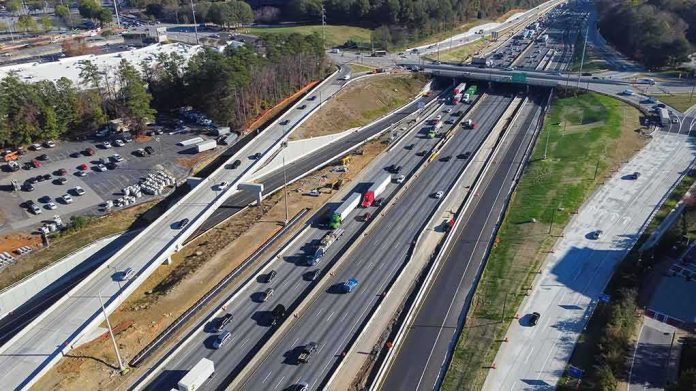
Shortly before 10 a.m. on October 20, 2026, a truck and a sedan collided on northbound Interstate 5 near Washington Street in San Diego’s Mission Hills neighborhood, according to the San Diego Union-Tribune and NBC 7, which both cited the California Highway Patrol and Caltrans for the location and timing. The impact left the truck’s cab tipped over the freeway’s center divider, suspended above the roadway below. Debris scattered across multiple lanes, fuel leaked from the wreckage, and the truck caught fire — a combination that, per CHP’s account to the Union-Tribune, forced closures in both directions of one of San Diego’s busiest arteries for hours while crews cleared the scene.
Outlets describe the vehicle inconsistently — as a box truck, a semi-truck, and a semi-tractor trailer — and none of the available reporting confirms a make, model, or carrier. That imprecision is unremarkable in the first hours after a chaotic scene; what matters for understanding the event is the agreed shape of it: a loaded commercial truck, a sedan, a collision violent enough to leave the cab teetering over an elevated roadway, and a fire that complicated an already dangerous rescue environment.
The Escape Caught on Camera
What turned a routine, if serious, freeway collision into a viral moment was the video. Multiple outlets, including ABC7 and ABC News, show the truck driver climbing out through the windshield of the dangling cab and dropping to the pavement, where bystanders had already gathered a blanket to catch him. A passerby video posted by ABC7 captures the same sequence: the driver emerging from the cab, dropping, and landing in the makeshift safety net assembled by strangers who had stopped their own vehicles to help. A second occupant of the truck was separately helped out through a window, according to NBC 7’s account attributed to CHP.
The footage is the kind of unscripted human moment that outlasts the news cycle that produced it — ordinary commuters, with no equipment and no training, improvising a rescue in the minute or two before professional responders could reach a truck hanging in open air above a live freeway. That instinct to act, documented on camera rather than described secondhand, is the reason this crash crossed from local traffic item to national video story within hours.
Injuries, Refusals, and the Numbers That Don’t Quite Match
Both occupants of the truck declined medical treatment at the scene, according to NBC 7’s reporting, which cited CHP’s account that the driver was ejected into the freeway lanes and the passenger was assisted out through a window before both refused care. Refusing treatment is not the same as being cleared of injury — emergency responders document a refusal, not a clinical diagnosis — but it is the only documented status available for the truck’s occupants, and it is consistent across the reporting on this incident.
The sedan’s occupants fared differently, and here the public record shows a minor but real discrepancy. The Union-Tribune reported that three people were taken to hospitals, while NBC 7 reported that four people in the sedan were treated or transported, a figure also attributed to San Diego Fire-Rescue in related coverage. Differences of this kind are common in fast-moving incident reporting, where early casualty counts shift as agencies update figures or as “treated at the scene” gets conflated with “transported.” The gap does not change the basic fact pattern — multiple people in the sedan required medical attention — but it is worth noting as an example of why initial breaking-news numbers should be treated as provisional snapshots rather than final tallies.
Why the Cause Still Matters More Than the Clip
The crash’s underlying mechanism — what sequence of braking, lane position, or speed put a commercial truck into a collision severe enough to leave its cab dangling over a freeway divider — has not been established in any of the available reporting. CHP’s investigation into cause and fault remains open, and no collision report, reconstruction, or citation has been made public. That is the ordinary pace of crash investigation: fault determinations and technical reconstructions take weeks, sometimes months, and are rarely resolved on the same day cell-phone video of the rescue circulates nationally.
Research into how crash coverage shapes public understanding helps explain the gap between what spreads and what gets resolved. A University of North Carolina study of road-safety media framing found that news posts featuring people directly involved in or witnessing a crash generated markedly stronger audience engagement than coverage focused on causation or traffic-safety policy. That pattern is visible here: the blanket rescue has been viewed, shared, and reposted far more widely than any account of the collision’s cause, simply because a dramatic human moment is more legible — and more shareable — than an unresolved investigative question.
The Larger Pattern in Viral Crash Footage
This incident is a clean example of a recurring dynamic in how the public actually learns about traffic crashes. The visual drama — a man escaping a burning, dangling cab into a blanket held by strangers — is unambiguous and emotionally resonant; the causal and administrative facts behind it — carrier identity, fault, precise injury counts, mechanical condition of the vehicle — are slower, messier, and far less likely to ever reach the same audience that saw the rescue clip. Readers who encountered this story through a short-form video or a reposted clip may never see the follow-up, if there is one, establishing what actually caused the crash. The rescue is real, well documented, and worth the attention it received. The investigation into why it happened is still ongoing, and that distinction is the one worth keeping in mind the next time a dramatic freeway video crosses your feed.
A dramatic rescue unfolded on a San Diego freeway after a truck wound up hanging over the roadway. The driver escaped through the windshield and dropped into a blanket held by bystanders as crews worked to clear the crash. pic.twitter.com/LHwqJ9IKty
— ABC7 Eyewitness News (@ABC7) October 22, 2026
Sources:
facebook.com, people.com, x.com, sandiegouniontribune.com, navbug.com, nbcsandiego.com